
Generous authority
& 3 years of this newsletter!

Hi,
I started this newsletter in October 2022 while living in a house in Salt Lake City that smelled irreparably of diarrhea (a longterm sewage leak in the basement that I, somehow, was the first tenant to notice). For me, this newsletter served as an announcement that I was embarking on the writing path. Each month has served as an opportunity to practice the cringy self-exposing act of saying—I wrote this, would you like to read it?
I’m writing this newsletter from a classroom in New York City eating kumquats and cold brew with a splash of half & half (actually a banger combination).1 I feel like I’ve traveled a long way from that Salt Lake City house. If I tried to walk the path backwards it might just be a long string of written words. I started on the writing path with an incredible amount of skepticism around authority. I worried that learning from “authorities” on writing would maim me in some way. That it would take me further from the magical/the unsayable/the floating end to a poem, and closer to that which is flat and lifeless; beautiful sentences with nothing inside them.2
I had every right to be skeptical of authority and I think there’s good reason for beginners in general to be skeptical of authority. It doesn’t matter if you’re good, it matters that you continue. Authority says stupid things like don’t write about sex or women’s stories aren’t important enough to sustain a literary novel. Authority is so often sexist/racist/etc, and great art rarely, if ever, comes from submission to authority. I started thinking about all this recently when I heard Emily Greenhouse say that we are living in an anti-authority authoritarian era. She was talking about the importance of art criticism (adding more info about this talk in a footnote so we don’t get fully derailed).3 In the past few years, I’ve learned so much more about writing, from a wide range of authorities on writing, and I’ve been surprised by how much more difficult and complex it’s made the writing process, but also how much deeper and more rewarding it’s become. It made me wonder, could I have a different relationship to authority rather than a full eyeroll denial? Could that actually be much better for me and my writing?
I started taking ceramics this year because I was tired of writing, and also, I aspire to make those short videos I see online of hot female potters with a bit of hair in their face molding a mound of clay while the wheel turns. It took me two weeks to center the clay and another four weeks to pull up a wall. I know which pieces are mine because they are usually lopsided with walls that are either too thin or too thick. In the first ceramics class I took, the teacher’s approach was very tidy—she wanted every woman in the class to make something like you might find at Crate & Barrel, and every woman in the class also wanted that for themselves. It was all a very tight and stressful process. This struck me as odd but who was I to really say because I couldn’t get my mound of clay to actually stick to the wheel, it kept flapping off onto the ground.
The second class I took had a very artistic, all art is good, wonky is wonderful approach to ceramics. If the first class I took was all authority and no magic (all steel container, no sauce), this class was all toddler-time wonder and no authority or constructive feedback. I’m still waiting to find that third class with a teacher who exercises generous authority rather than total relativism. Generous authority rather than a minuscule sort of utilitarianism that isn’t artful at all.
When I feared authority around art, I pictured it as a thing that would just barrage down upon me. I forgot that I have agency to take from authorities what works for me, and to identify people who have both authority and generosity. Generous Authority helps you to love the work better by allowing it more complexity. I hope that I can live to see our culture shift into a period led by generous authority in all fields. One of my favorite generous authorities on fiction writing is George Saunders. He said in a talk recently that high quality prose is a sort of mind-to-mind contact, a deep empathy that we can’t find anywhere else.4 If I care about the empathy, I have to care about the quality. I have to seek out the generous authority to help with the quality. Does that make any sense? As I learn more, I hope to develop this sort of generous authority. If I lose the generous and just become an authority, I’ll feel like I failed.
something to read
The dark days of the year are here and it’s time to light a candle and read. I think a long book should be started now and finished in that week between Christmas and New Years where time loses shape and everything becomes an eerily calm yet irritable eon.
The Loneliness of Sonia and Sonny by Kiran Desai
The Bee Sting by Paul Murray
The Sisters by Jonas Khemiri
Middlemarch by George Eliot (though this book is boring, it may be better reserved for summer when more light allows for more space for boredom)
Jonathan Strange & Mr. Norrell by Susanna Clarke
Pachinko by Min Jin Lee
Anna Karenina by Tolstoy
My Brilliant Friend series by Elena Ferrante
Lonesome Dove by Larry McMurtry
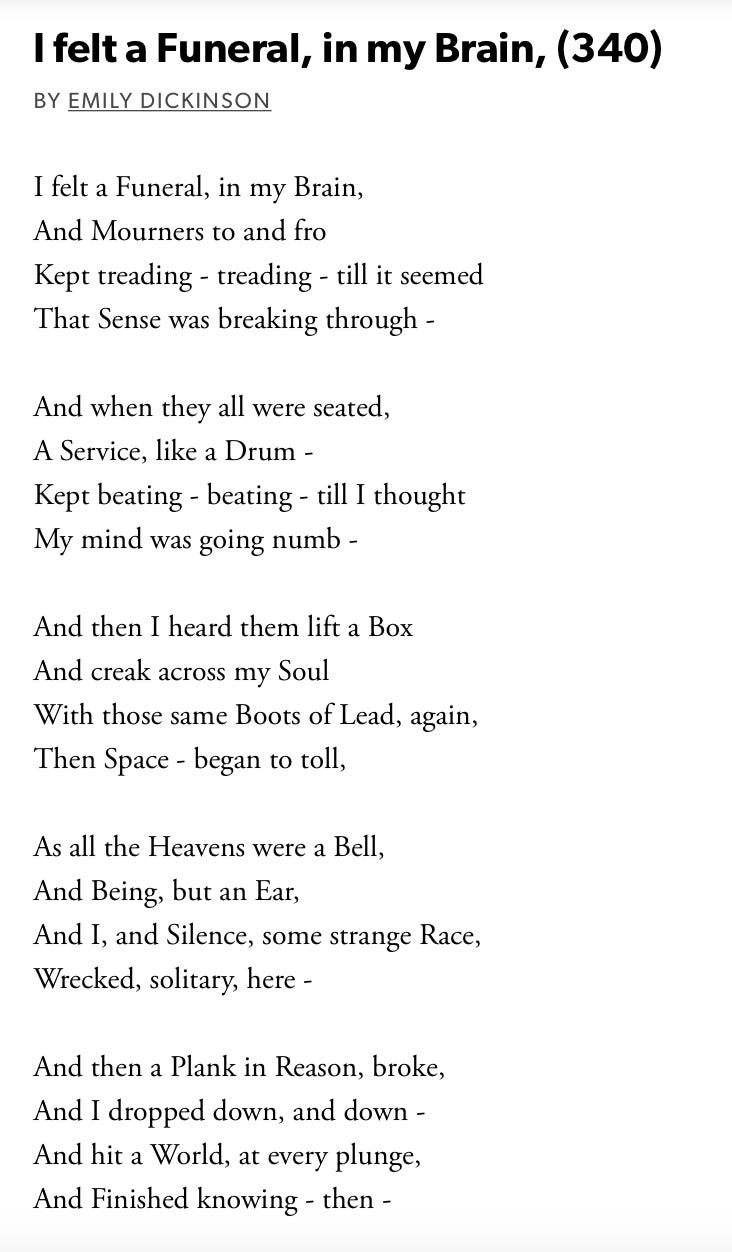
I’ve been teaching a poetry unit in my NYU class, which is very new for me. I think this time of year (this moment in history) is a beautiful time to start a poetic practice. Unlike the other forms of media we consume, poetry is non-assaultive. I encourage my students to cultivate a poetic presence before meeting a poem. Feel your feet on the floor, notice six things you see in the room, then read the poem quietly. Return to your poetic presence, then read it once again outloud.
Another item of note from this month is Lily Allen’s new album, West End Girl. I listened to Lily Allen so much in middle school and it was such a delight to see her back with a middle-aged fury. The album tells in glorious detail the story of her opening up her relationship with her husband, and him violating all the rules. The best art feels like you’re overhearing a secret, and this album contains secrets galore.
I’m also really looking forward to seeing the Good Sex play in New York this month. Two actors meet on stage and see the script for the first time when the show starts.
Thank you for reading! If you’ve been here since the beginning, you truly are the best.
Zoe
Side bar: It took the shopkeeper seven minutes to find the code for kumquat when I was checking out, and while I was waiting I was thinking about the David Foster Wallace graduation speech ‘This is Water’ that I looked up that morning because my friend KT said she used to have boys write three paragraph essays in response to it if they wanted to take her out. The speech is all about how you get to choose how to be interested in the world, you get to choose how to think. He said that even before smart phones allowed you to be in a dinging loop that allows for no thoughts at all. She did eventually find the code for kumquats and they really are delightful, the sweetness of the flesh and sourness of the skin. The flavor stays in your mouth for a long time after eating them so anything else you drink like water or cold brew has a citrus after flavor like there’s an kumquat flavored air freshener in your mouth.
Side bar: I heard a story about a friend of a friend that had a very famous writer tell them that their sentences were beautiful but they needed to go to therapy because it seemed that they had never had an emotional experience).
It was a talk by the Editor of New York Review of Books, Emily Greenhouse. Ask for a subscription to NYRB for Christmas!
I think I’m the only person in the world who didn’t enjoy the “My Brilliant Friend” series. This is the second time in a few weeks that someone has recommended “Lonesome Dove,” so maybe that’s a sign that I should read it.
Wooohooo